
PROJECT INFORMATION
Technical information
Essential information on grating design, surface finishes, anti-slip options and safe installation, together with the available technical tables and documents.
Grating design and ordering information
The basic information we need to design the correct grating.
Surface finish
When to choose hot-dip galvanising, electro-galvanising or powder coating.
Fastening and installation
Principles for supporting and securing gratings and preparing for installation.
TECHNICAL GUIDE • 01/04
Design of gratings and how to order
DESIGN PRINCIPLE
Press-locked grating
A press-locked grating consists of bearing bars and non-bearing cross bars. Their orientation, mesh size and dimensions are selected to suit the support arrangement and required load capacity.
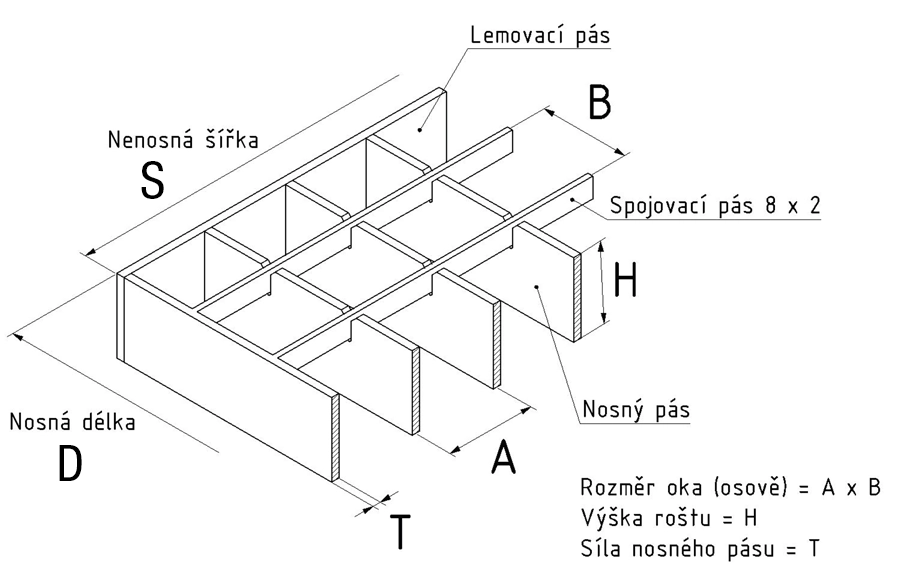
Výrobní typy ok a nosných pásů
PDF dle DIN 24537
Nosnost roštů, oko 30 x 30 mm
PDF tabulka zatížení
Konstrukce lisovaného roštu
PDF technický přehled
HOW TO SPECIFY GRATINGS
Information required for ordering
To prepare a quotation, we need the grating type, dimensions, intended use, environment and load characteristics. KASALI then specifies the structural design.
Grating type
Floor / rack grating
Specify the required product group and intended use.
PROVIDED BY THE CUSTOMER
Grating dimensions
D x S
State dimensions as bearing-bar length × cross-bar width, for example 1,300 × 650 mm. The clear span between supports is also important.
PROVIDED BY THE CUSTOMER
Surface finish
Zinc coating to suit the environment
Hot-dip galvanising for outdoor and damp environments; electro-galvanising mainly for dry interiors.
SELECTED BY THE CUSTOMER WITH KASALI GUIDANCE
Bearing bar
H x T
We specify the bearing-bar depth and thickness to suit the span, support arrangement and load, for example 40 × 3 mm.
SPECIFIED BY KASALI
Mesh size
A x B
Mesh size and orientation are selected to suit the application, safety requirements and load characteristics, for example 34 × 66 mm.
SPECIFIED BY KASALI
Cross bar
Non-bearing structural element
We determine the cross-bar dimensions according to the grating type and design, for example 8 × 2 mm.
SPECIFIED BY KASALI
Load capacity and loading
Type of load application
State both the load value and how it is applied: uniformly distributed, point or line load, pallet load or wheel load. A value in kg/m² alone may not be sufficient.
PROVIDED BY THE CUSTOMER • VERIFIED BY KASALI
Quantity
Quantity for each item
State the required quantity for each size and design.
PROVIDED BY THE CUSTOMER
Do you have a specific brief?
You do not need to know every design parameter
Send us the intended use, dimensions, support arrangement and loads. Our engineering team will specify the bearing bars, mesh and cross bars.
TECHNICAL GUIDE • 02/04
Surface finish
The surface finish is selected according to the environment, required durability and appearance. We offer three basic options for common industrial applications.
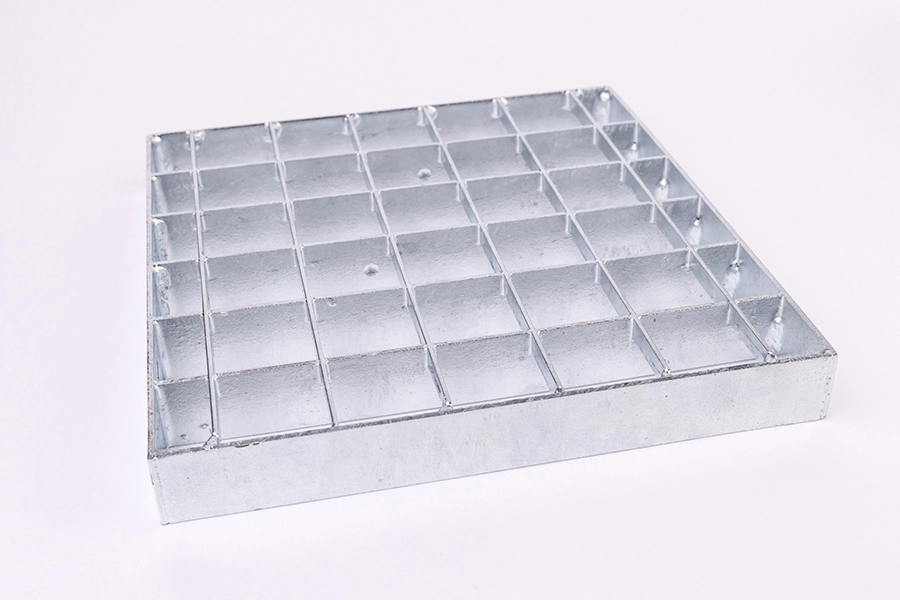
OUTDOOR ENVIRONMENT
Hot-dip galvanised
The standard choice for outdoor structures, handling areas and operations exposed to moisture.
- Higher corrosion resistance
- Durable industrial finish
- Suitable for outdoor use
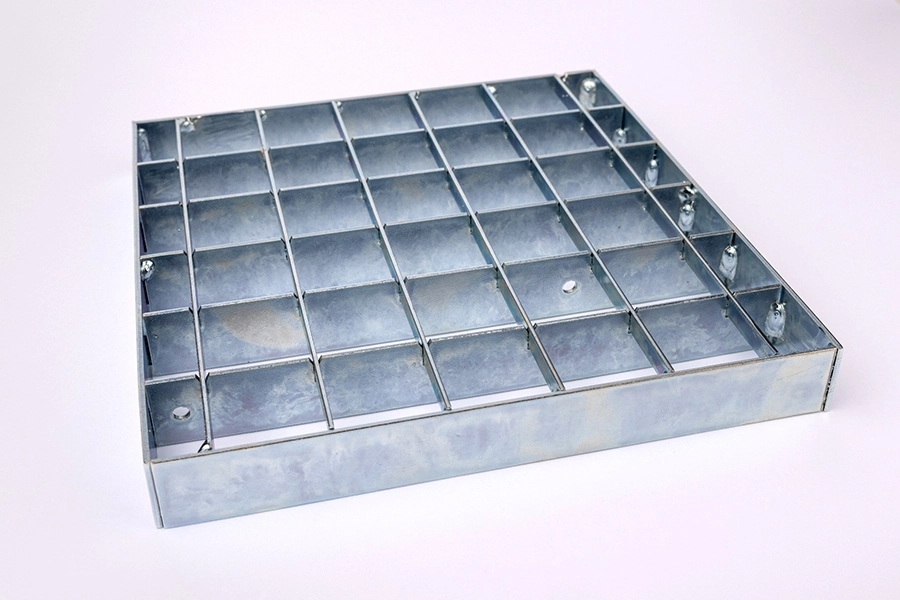
DRY INTERIOR
Electro-galvanised
Particularly suitable for warehouse interiors without exposure to outdoor moisture.
- Smoother, brighter appearance
- Suitable for warehouses
- Clean surface appearance
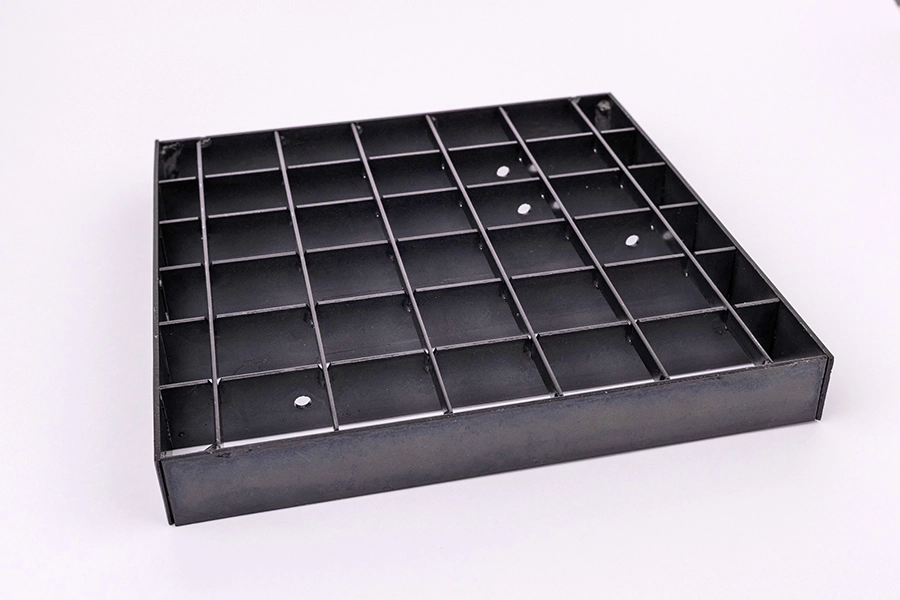
DISTINCTIVE APPEARANCE
Powder coating
A coloured grating finish with a durable, uniform surface.
- wide range of RAL colours
- durable, easy-to-maintain surface
- colour coordination with the structure or facility
WHAT AFFECTS THE CHOICE?
Location and moisture
First distinguish between dry interiors, unheated buildings and outdoor use. Local exposure to water, condensation or chemicals must also be considered.
Handling and mechanical stress
For rack infill and trafficable surfaces, the frequency of handling, contact with pallets and potential surface damage should be considered.
Appearance and integration with the structure
For visible components, the finish can be coordinated with the adjoining steelwork. We recommend approving the colour and final appearance before production.
RELATED DOCUMENTS
Zinc information
Information on galvanising methods
Need advice for your operating environment?
Describe the grating location and operating conditions and we will recommend a suitable finish.
TECHNICAL GUIDE • 03/04
Anti-slip design
Anti-slip gratings are used where moisture, dust or process residues may reduce grip. The appropriate type must be selected according to the risk and use of the surface.
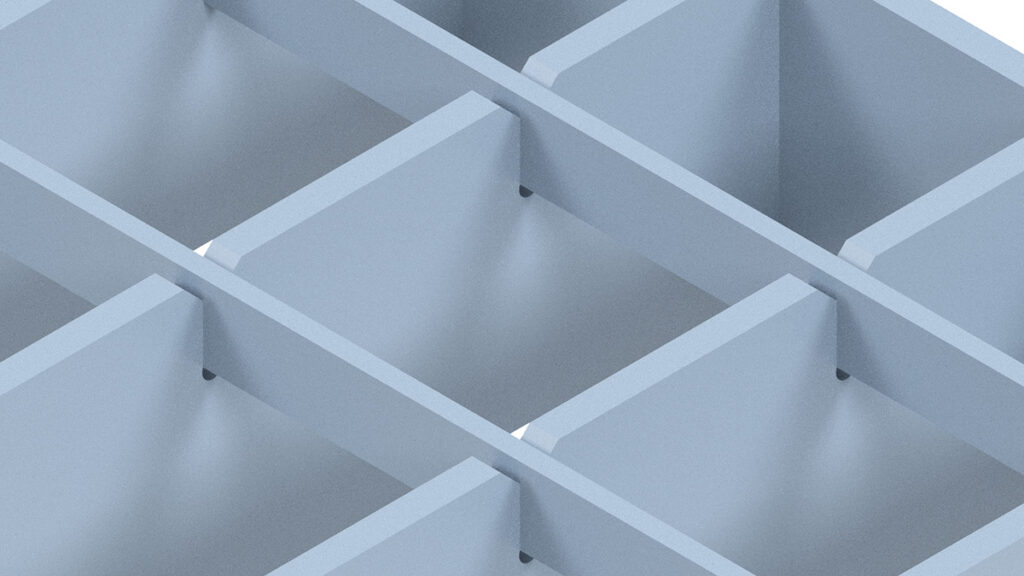
type P, R10
Plain design
Plain bearing and cross bars for standard areas without an increased slip risk.
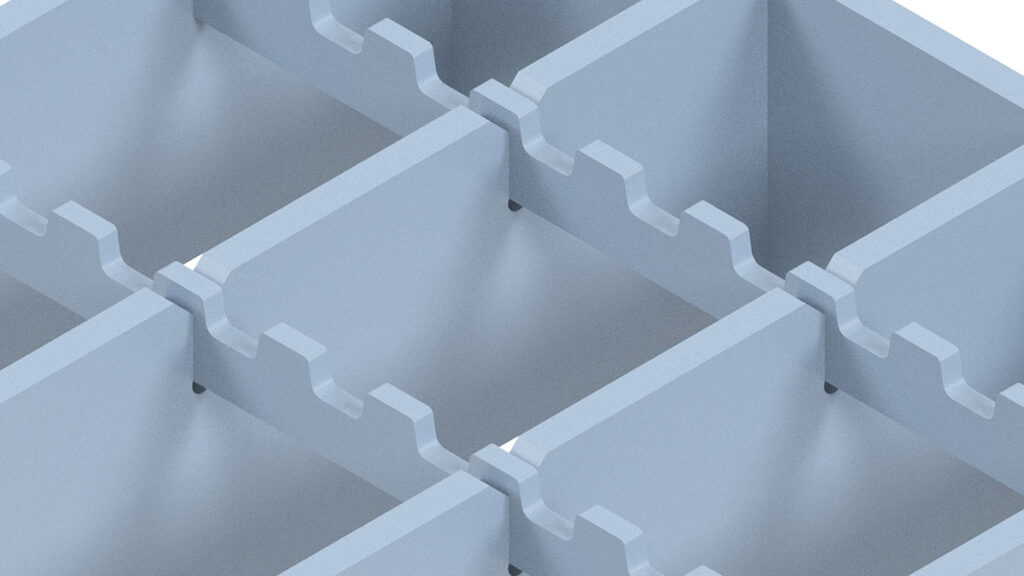
type P/S2, R11
Serrated cross bars
Improved slip resistance with standard bearing bars.
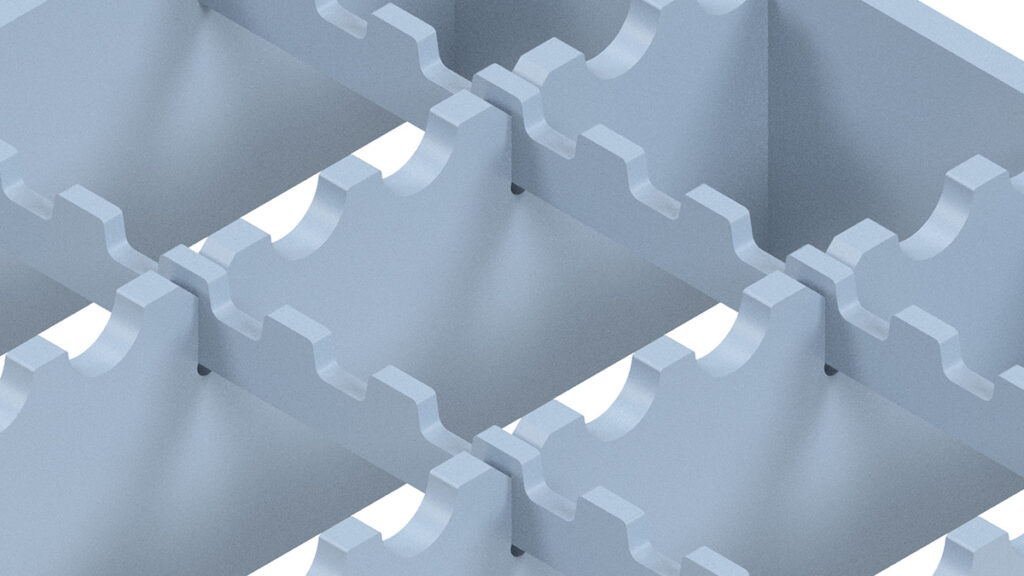
type P/S1, R12
Serrated in both directions
Serrated bearing and cross bars for areas with increased anti-slip requirements.
DESIGN GUIDANCE
Assessment of the specific application
The slip-resistance class is only one criterion. Gradient, traffic frequency, footwear and substances that may occur on the surface must also be considered.
Grating stair treads
For stair treads, the anti-slip design is supplemented by a nosing. The final solution depends on the stair location and project requirements.
Maintenance of walking surfaces
Regular cleaning and the removal of dirt also affect safety. Grating and mesh size are therefore selected with the actual maintenance regime in mind.
Which design should you choose?
Send us the application, location and expected contamination. We will verify the design with you.
TECHNICAL GUIDE • 04/04
Fastening and installation
Basic installation rules
Adequate bearing length
Where possible, the bearing length in the direction of the bearing bars should be at least equal to their depth and no less than 25 mm.
Securing against movement
The grating must be secured against shifting and lifting using suitable fasteners or the solution specified in the project.
At least four fixing points
Standard installation requires at least four fasteners per grating; the specific design may require more.
BEFORE INSTALLATION
Check the supporting structure
Check the clear span, level, support width and alignment of adjoining bays. The grating must not be installed with the bearing bars in the wrong direction.
Select the fixing type
The decision depends on mesh size, support profile, access from below and whether drilling into the structure is permitted.
Installation and laying plan
For larger areas, we recommend a numbered layout plan showing the position of each grating, cut-out and fixing element.
Grating fastener options
Link to the grating fasteners page
Standard and custom components for securely fixing gratings to the supporting structure.

TECHNICAL CONSULTATION
Need an installation proposal?
Send us a drawing of the supporting structure. We will prepare a suitable fastening solution or layout plan.
DOWNLOADS
Tables, standards and certification
Detailed information is readily available to designers, engineers and customers.
Press-locked grating design
Download PDF
Grating load capacity, 30 × 30 mm mesh
Download PDF
Standard stair-tread dimensions
Download PDF
Download catalogue
Download PDF
